
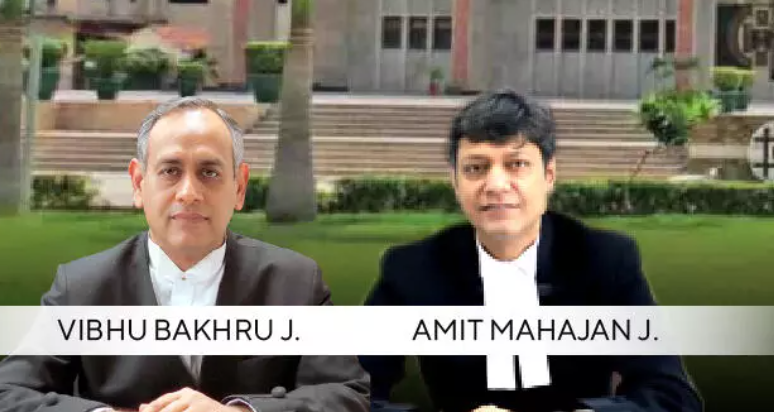
The Division Bench of the Delhi High Court in Govind Singh v. M/s Satya Group P. Ltd. [Neutral Citation 2023/DHC/000081] has delivered a recent judgment examining the law relating to the validity of an award passed by an ineligible arbitrator. The Bench further held that mere participation by a party in the arbitral proceedings would not constitute a waiver of their rights to object to the ineligibility of the arbitrator. The observations of the Bench, are as under:
“50. First, we shall deal with Clause (d). There is no quarrel that by virtue of Section 12(5) of the Act, if any person who falls under any of the categories specified in the Seventh Schedule shall be ineligible to be appointed as the arbitrator. There is no doubt and cannot be, for the language employed in the Seventh Schedule, the Managing Director of the Corporation has become ineligible by operation of law. It is the stand of the learned Senior Counsel for the appellant that once the Managing Director becomes ineligible, he also becomes ineligible to nominate. Refuting the said stand, it is canvassed by the learned Senior Counsel for the respondent that the ineligibility cannot extend to a nominee if he is not from the Corporation and more so when there is apposite and requisite disclosure. We think it appropriate to make it clear that in the case at hand we are neither concerned with the disclosure nor objectivity nor any such other circumstance. We are singularly concerned with the issue, whether the Managing Director, after becoming ineligible by nor impartiality operation of law, is he still eligible to nominate an arbitrator. At the cost of repetition, we may state that when there are two parties, one may nominate an arbitrator and the other may appoint another. That is altogether a different situation. If there is a clause requiring the parties to nominate their respective arbitrator, their authority to nominate cannot be questioned. What really in that circumstance can be called in question is the procedural compliance and the eligibility of their arbitrator depending upon the norms provided under the Act and the Schedules appended thereto. But, here is a case where the Managing Director is the “named sole arbitrator” and he has also been conferred with the power to nominate one who can be the arbitrator in his place. Thus, there is subtle distinction. In this regard, our attention has been drawn to a two-Judge Bench decision in State of Orissa v. Commr. of Land Records & Settlement, In the said case, the question arose, can the Board of Revenue revise the order passed by its delegate. Dwelling upon the said proposition, the Court held: (SCC p. 173, para 25)“25. We have to note that the Commissioner when he exercises power of the Board delegated to him under Section 33 of the Settlement Act, 1958, the order passed by him is to be treated as an order of the Board of Revenue and not as that of the Commissioner in his capacity as Commissioner. This position is clear from two rulings of this Court to which we shall presently refer. The first of the said rulings is the one decided by the Constitution Bench of this Court in Roop Chand v. State of Punjab. In that case, it was held by the majority that where the State Government had, under Section 41(1) of the East Punjab Holdings (Consolidation and Prevention of Act, 1948, delegated its appellate powers vested in it under Section 21(4) to an “officer”, an order passed by such an officer was an order passed by the State Government itself and “not an order passed by any officer under this Act” within Section 42 and was not revisable by the State Government. It was pointed out that for the purpose of exercise of powers of revisions by the State under Section 42 of that Act, the order sought to be revised must be an order passed by an officer in his own right and not as a delegate of that State. The State Government was, therefore, not entitled under Section 42 to call for the records of the case which was disposed of by an officer acting as its delegate.”
(emphasis in original)53. The aforesaid authorities have been commended to us to establish the proposition that if the nomination of an arbitrator by an ineligible arbitrator is allowed, it would tantamount to carrying on the proceeding of arbitration by himself. According to the learned counsel for the appellant, ineligibility strikes at the root of his power to arbitrate or get it arbitrated upon by a nominee.
54 In such a context, the fulcrum of the controversy would be, can an ineligible arbitrator, like the Managing Director, nominate an arbitrator, who may be otherwise eligible and a respectable person. As stated earlier, we are neither concerned with the objectivity nor the individual respectability. We are only concerned with the authority or the power of the Managing Director. By our analysis, we are obligated to arrive at the conclusion that once the arbitrator has become ineligible by operation of law, he cannot nominate another as an arbitrator. The arbitrator becomes ineligible as per prescription contained in Section 12/5) of the Act. It is inconceivable in law that person who is statutorily ineligible can nominate a person. Needless to say, once the infrastructure collapses, the superstructure is bound to collapse. One cannot have a building without the plinth. Or to put it differently, once the identity of the Managing Director as the sole arbitrator is lost, the power to nominate someone else as an arbitrator is obliterated. Therefore, the view expressed by the High Court is not sustainable and we say so.”
“21. But, in our view that has to be the logical deduction from TRF Ltd. [TRF Ltd. v. Energo Engg. Projects Ltd., (2017) 8 SCC 377 : (2017) 4 SCC (Civ) 72] Para 50 of the decision shows that this Court was concerned with the issue, “whether the Managing Director, after becoming ineligible by operation of law, is he still eligible to nominate an arbitrator” The ineligibility referred to therein, was as a result of operation of law, in that a person having an interest in the dispute or in the outcome or decision thereof, must not only be ineligible to act as an arbitrator but must also not be eligible to appoint anyone else as an arbitrator and that such person cannot and should not have any role in charting out any course to the dispute resolution by having the power to appoint an arbitrator. The next sentences in the paragraph, further show that cases where both the parties could nominate respective arbitrators of their choice were found to be completely a different situation. The reason is clear that whatever advantage a party may derive by nominating an arbitrator of its choice would get counter-balanced by equal power with the other party. But, in a case where only one party has a right to appoint a sole arbitrator, its choice will always have an element of exclusivity in determining or charting the course for dispute resolution. Naturally, the person who has an interest in the outcome or decision of the dispute must not have the power to appoint a sole arbitrator. That has to be taken as the essence of the amendments brought in by the Arbitration and Conciliation (Amendment) Act, 2015 (3 of 2016) and recognised by the decision of this Court in TRF Ltd. [TRF Ltd. v. Energo Engg. Projects Ltd., (2017) 8 SCC 377 : (2017) 4 SCC (Civ) 72]”
“28. In TRF Ltd. [TRF Ltd. v. Energo Engg. Projects Ltd., (2017) 8 SCC 377 : (2017) 4 SCC (Civ) 72] , the Managing Director of the respondent had nominated a former Judge of this Court as sole arbitrator in terms of the aforesaid Clause 33(d), after which the appellant had preferred an application under Section 11(5) read with Section 11(6) of the Act. The plea was rejected by the High Court and the appeal therefrom on the issue whether the Managing Director could nominate an arbitrator was decided in favour of the appellant as stated hereinabove. As regards the issue about fresh appointment, this Court remanded the matter to the High Court for fresh consideration as is discernible from para 55 of the judgment. In the light of these authorities there is no hindrance in entertaining the instant application preferred by the applicants.”
“20. This then brings us to the applicability of the proviso to Section 12(5) on the facts of this case. Unlike Section 4 of the Act which deals with deemed waiver of the right to object by conduct, the proviso to Section 12(5) will only apply if subsequent to disputes having arisen between the parties, the parties waive the applicability of sub-section (5) of Section 12 by an express agreement in writing. For this reason, the argument based on the analogy of Section 7 of the Act must also be rejected. Section 7 deals with arbitration agreements that must be in writing, and then explains that such agreements may be contained in documents which provide a record of such agreements. On the other hand, Section 12(5) refers to an “express agreement in writing”. The expression “express agreement in writing” refers to an agreement made in words as opposed to an agreement which is to be inferred by conduct. Here, Section 9 of the Contract Act, 1872 becomes important. It states:
“9. Promises, express and implied. -Insofar as the proposal or acceptance of any promise is made in words, the promise is said to be express. Insofar as such proposal or acceptance is made otherwise than in words, the promise is said to be implied.”
It is thus necessary that there be an “express” agreement in writing. This agreement must be an agreement by which both parties, with full knowledge of the fact that Shri Khan is ineligible to be appointed as an arbitrator, still go ahead and say that they have full faith and confidence in him to continue as such…”